
The Rationale behind the panchagam:
(For those who want to learn just on how to use Vakya Panchagam can skip to this section)
Before learning how to use Vakya Panchangam, one must have at-least a very little knowledge about why are we even using Panchangam.
So, Generally, People use Panchangam to choose a favorable time usually called a ‘Muhurta’, when they need to start any new venture. Or, just for any day-to-day events which one hopes to begin and end with success. i.e., to expect all the events to happen according to one’s wish without any hindrance.
Those who follow the Hindu tradition, the mindset to use Panchangam daily is very much strongly rooted in their belief because they believe that not all the events that happen in one’s life totally come in their control. Most often than not, events are always combined with effort and destiny. Say, one part is logical (Effort), and the other is (seemingly) illogical (Destiny/Fate).
Let’s consider an example to understand the ‘ Effort-Destiny ‘ idea.
A person has planned to board a flight at 6:00 am the next day morning, his ticket is ready, his cab from home to the airport will be on time and everything is planned well ahead. Up to this point, all looks like his effort, which is totally in his control. This effort and the situations that seem to be in total control is the logical part.
And now, the next morning when he started from home ahead of time to board the cab, by chance he slipped in the staircase and met with a minor injury in his leg that canceled his trip. Though he used to be, by nature a very careful person, this accident is totally unexpected which is not in his control. Why this happened exactly now and why not after the trip, such questions can never be explained logically. Because, this part is what we call ‘the illogical factor’, that influences everyone’s life – Destiny.
(Note: The cause and effort of the positive and negative events in one’s life have a bigger picture to understand that involves the karma theory, which is totally philosophical and does not form the scope of this article. So, what is outlined here is just a very rough idea to start with, that explains why people use Panchagam and learn how to use it)
Since we now know what is the cause for the unforeseen happenings, we will see how to take advantage of the ready-made system that is available to our help. Not all can learn Vedic Astrology, which is a very sensitive and vast subject, but to help us with our current situation, it provides us with few major pointers to follow on that solves the problem. These pointers are called tithi, vara, nakshatra, yoga and Karana, 5 of them. Each of them individually or combined, has its own positive and negative influence according to the nature of the events. These 5 pointers together called Panchangam, is what that influences any particular day. The word ‘Pancha’ means the number 5, and ‘anga’ means parts. This explains us that there are 5 parts that influences a day.
This page’s scope is limited to learn how to read and use Vakya Panchangam. But if you are totally new to the word Panchagam as such and first want to know at least a little on how to use these 5 Angas when choosing a good time for an event, then click here to know how to easily find an auspicious muhurta using Vakya Panchagam.
How to Read Vakya Panchangam :
(Updated 18th Feb 2020: Since many users asked questions related to calculations and other things in comment section, we’ve updated the post to include them in a structured way.)
Now we will see how to read the Panchanga, the 5 parts, for any time on a particular day from ‘Suddha Vakya Panchanga or Pambu Panchangam.
Let’s consider an example:- To know whats the Thithi, Vara, Nakshatra, Yoga and Karana for the time [8:00am 27th July 2014]
Step 1: Simply traverse through the pages and look for the column title “இங்” in the 10th column, which means monthly dates according to English calendar. Now, locate the date : 27th for the corresponding month – July.
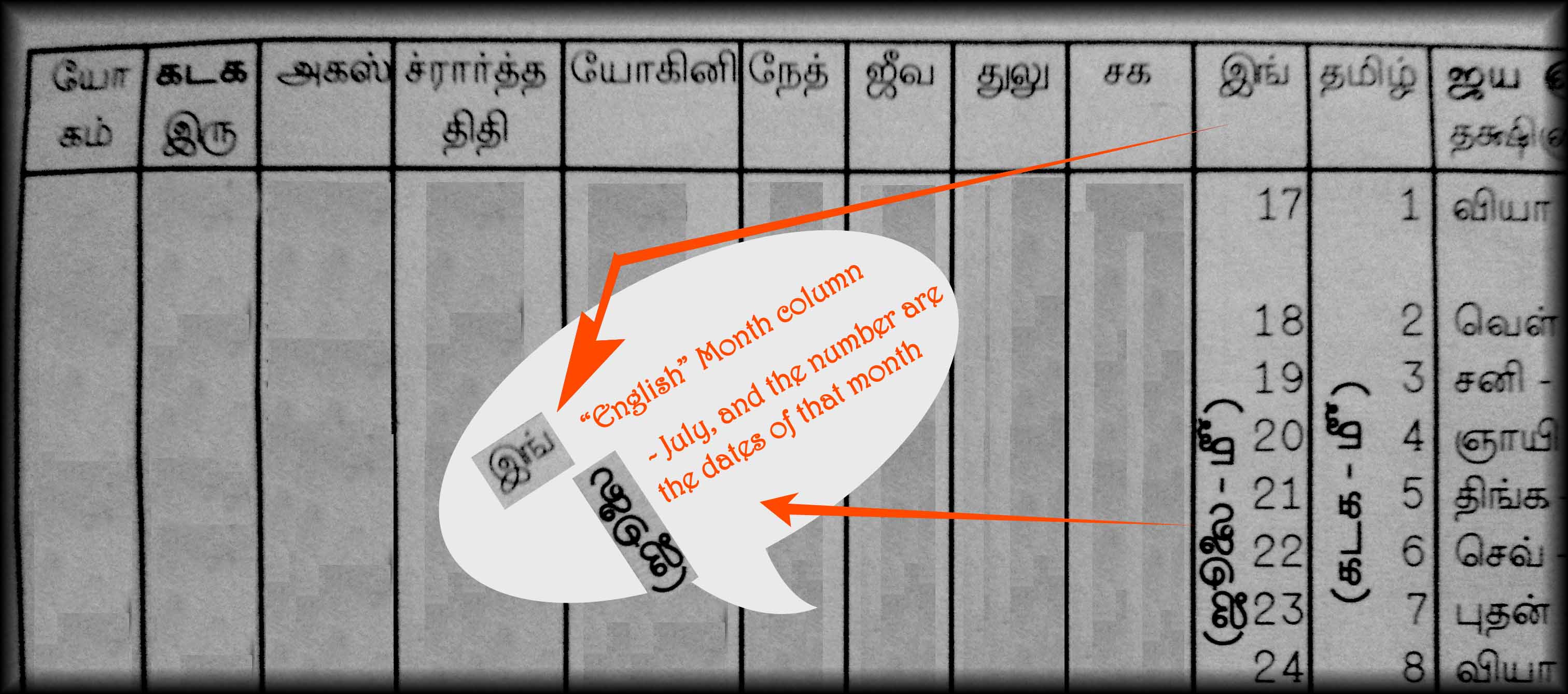
Step 2: Now isolate the row against 27th July.
Step 3: Check the following image to know the 5 elements of panchanga.
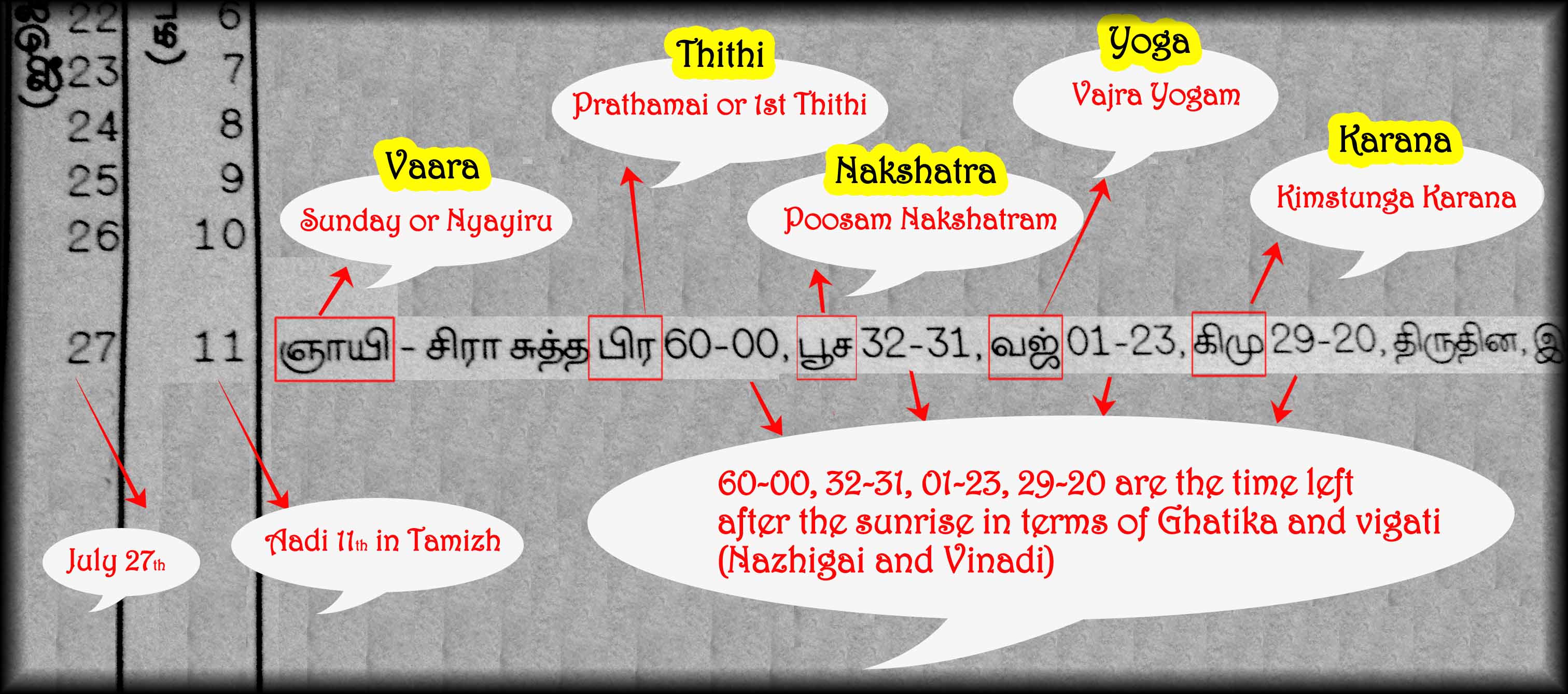
Thats it. As per Vedic Vakya Panchangam, you have learnt that on:
27th July’s Vāram is a Sunday.
Tithi is Prathamai (which is 1st tithi) which ends in 60-00 time, and the next tithi (dwitiyai) starts.
Nakshatram is Poosam, which ends in 32-31 time. After that, next nakshatra “Ayilyam” begins.
Yoga is Vajram, which ends in 01-23 time.
and the Karanam is “Kimstunga” which ends in 29-20 time. Simple and straight forward right? Okay now, let find out whats the end time that we were talking about in four of the 5 angas.
That is, how to easily calculate Tithi, Nakshatra, Yoga and Karana’s end Time in just 2 steps :
Just like how we equate 1 hour = 60 mins, in Vedic time system, 1 Nazhigai = 24 mins (approx.) and 1 Vinaadi = 24 seconds (approx.). We’ll use these time units to convert Vedic time to our time value in HH:MM below.
So now, What does this time value tell us? for example, what does Prathamai 60-00 or Poosam 32-31 in the picture mean?
It is the balance time left for that tithi or nakshatra to end, starting from the sunrise time on that day.
In our example, on Sunday which is the vaara, the tithi prathamai is 60-00 time left, and poosam nakshatram is 32-31 time left to end and next tithi or nakshatra to start. This we have to calculate from the sunrise on that day. We’ll see how to do this in simple steps below.
Now that we know where to look for tithi, vaara, nakshatra etc for a particular date and how to find their end time, we’ll also get to know a little more about the few other columns that are more frequently used. Before we do that, just have a glance at the picture below.
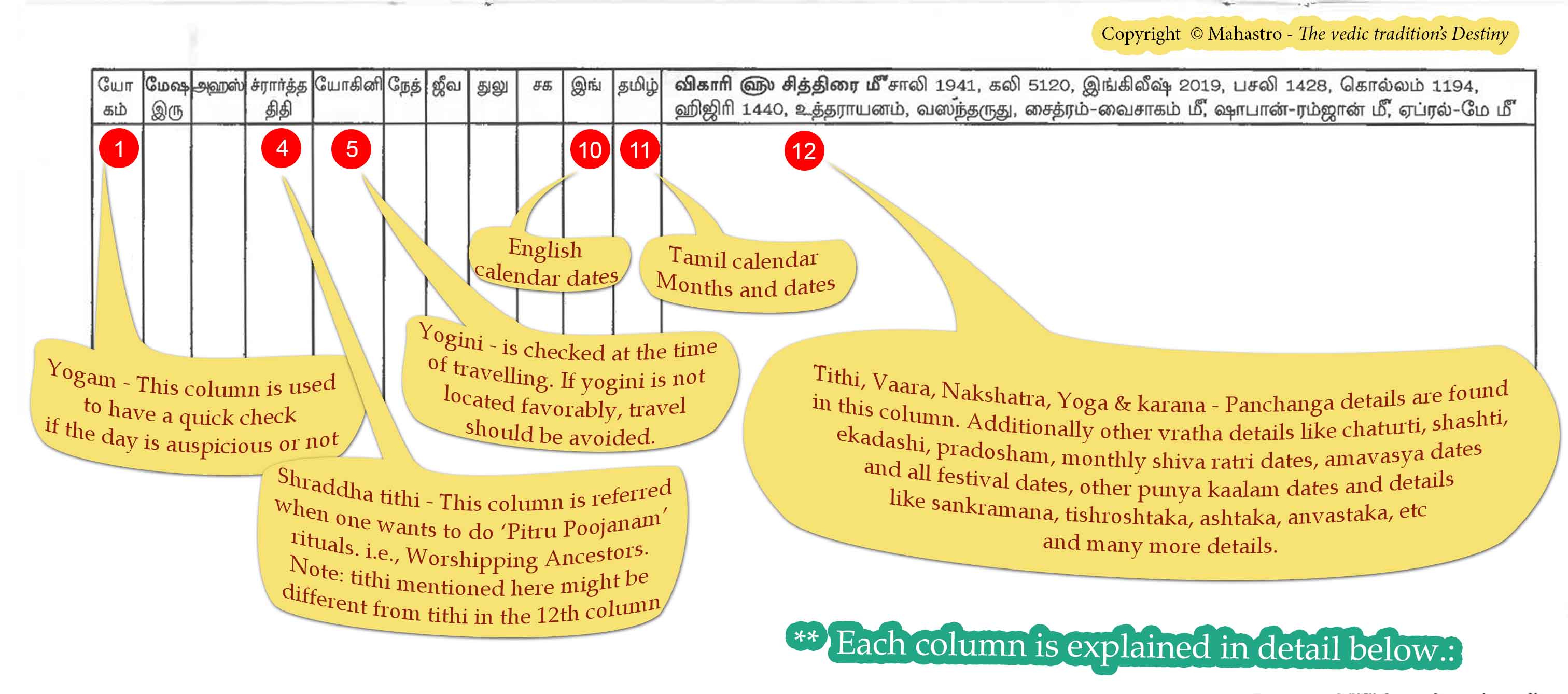
Yogam – Column 1 :
‘அ’, ‘சி’ and ‘ம’ (aa, si, ma) – Stands for ‘Amrita’, ‘Siddha’ and ‘Marana’ yogas respectively.
Based on just nakshatra and weekday combination, a chart is devised to arrive at these 3 yogas.
For example, Whenever Thiruvonam (Sravana) Nakshatram falls on Sunday, it will be ‘அ’ – Amrita Yoga.
Likewise, All the 27 nakshatras falling on different weekdays will result in either one of these 3 yogas, which is always fixed. Check the below chart for reference. Also, you can find the same chart on the first page of your Vakya Panchangam. This tabular column explains what combinations of a day and a star will form ‘Amrita’, ‘Marana’ and ‘Siddha’ yogas. Both ‘Amrita’ and ‘Siddha’ yoga are favourable yogas used for any auspicious events and the other one is ‘Manara’ Yoga which is obviously inauspicious. Now, we’ll consider a tricky example to understand how sometimes there are many yogas formed for a single day.
For this, we’ll consider Feb 21st, 2019, i.e., Maasi 9th. It’s a Thursday with 3 Yogas forming on the same day. Because, at times, there will be cases where even 3 nakshatras can also fall on a single day one after the other. Remember, a Vedic day starts from sunrise and extends till the next day’s sunrise. Now, with the help of the chart below find the yogas for the 3 nakshatras on Thursday. Here, in this case, Pooram (3-22 nazhigai) is the first nakshatra to start with, followed by Uttram (58-28) occupying for the most part of the day, and finally, before next day’s sunrise (friday’s), which is still as per Vedic system is Thursday, we also have Hastam Nakshatra for around 3 nazhigai. That’s why we have ‘சி’, ‘ம’, ‘சி’.
To get how long each yogam period is left and the next one starts, check the above section where we have explained the calculation part in simple steps.
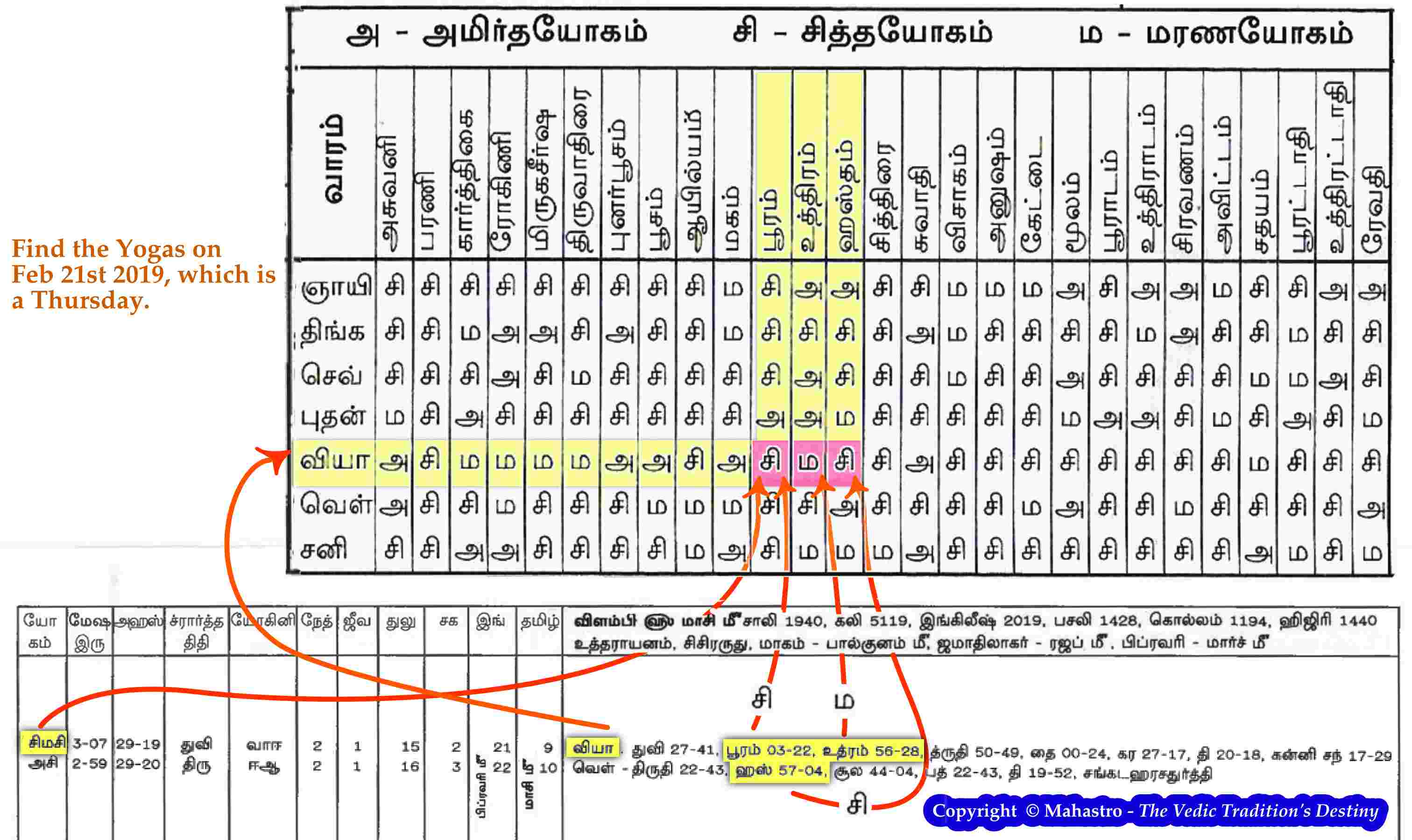
Though Feb 21st, 2019 date which has 3 different yoga is a very good example to understand how different yogas are calculated, as per Jyotish Shastra those weird combinations with 3 nakshatras or 3 thithis that falls on a single day should always be avoided for anything auspicious.
Also, Though we use this standard chart for so many years in our Pambu Panchangam, there are many confusions regarding these combinations still exist. That is, as per our standard text like Kalaprakashika or other muhurat grantas, we have different readings that contradict this chart in many places. So, use it with caution or consult an astrologer if you want to choose a muhurta for something very important.
** Since the scope is limited to know how to find yoga, we’ll cover those contradicting yogas exclusively in a separate post later.
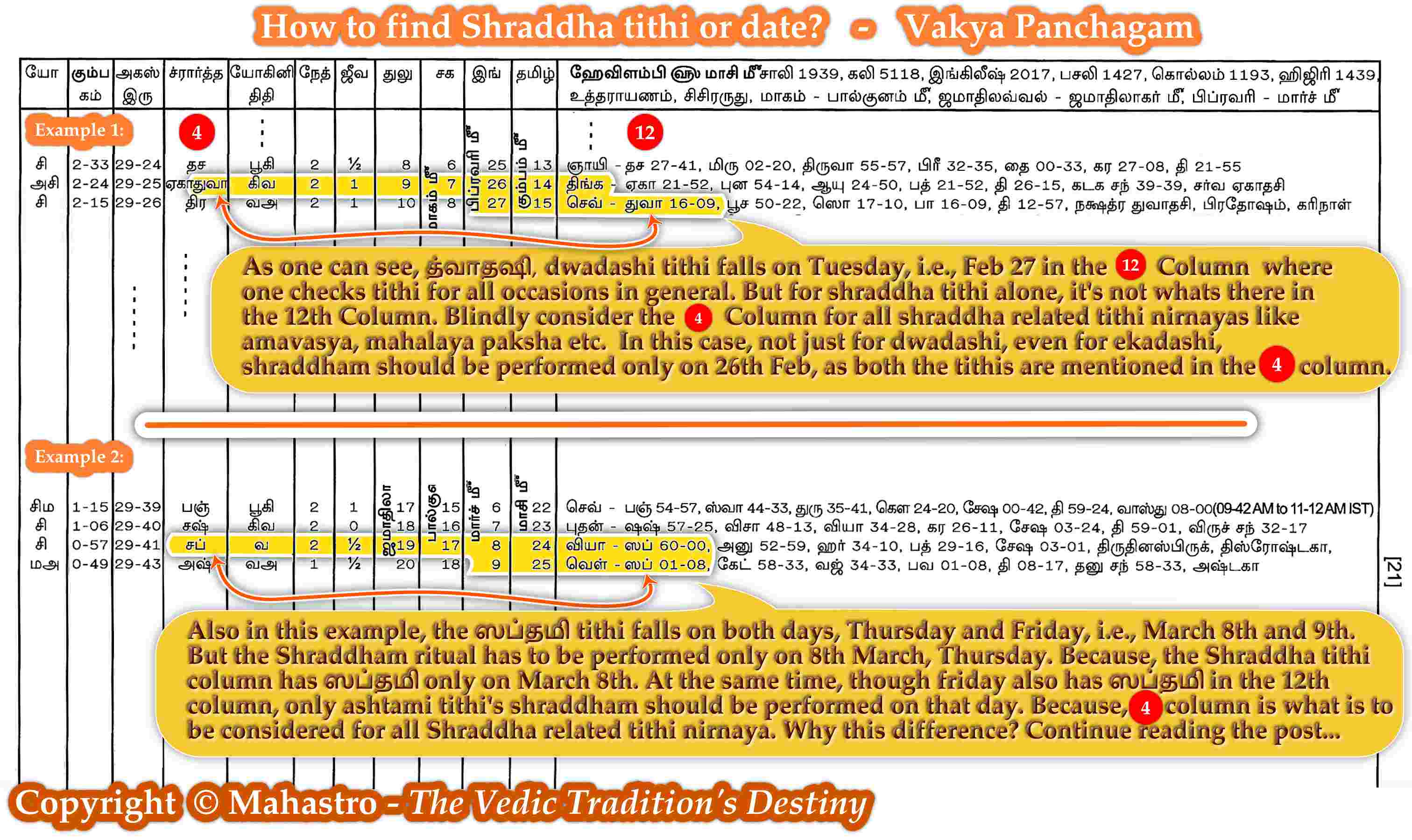
The rest of the other column’s explanation from Shrāddha tithi – Column 4 are continued here – ” How to read tamil vakya panchangam – Part 2 ” …
What does 32-31 in time mean? Does it mean that pushya nakshatra is there till 28th July 8:32 am????
But then how to interpret 60 next to tithi.
Hi Srinivasan,
Thanks for writing in.
32-31 is the balance time left for that nakshatra to end and the next one to start. The balance time is mentioned as per Vedic system.
32 is Nazhigai(Ghatika) and 31 is Vinadi(Vighati).
1 Nazhigai is approximately 24 minutes and 1 Vinadi is 24 Seconds approx.
So, doing the math like this (32 x 24mins)+(31 x 24 secs) , we get 780 mins and 24 secs which is 13hrs 24secs.
So, add this 13hrs and 24 sec from sunrise ( if we consider sunrise on that particular day to be 6.00 am), the total time left for “Poosam” nakshatra to end in standard time will be 7:00:24pm (Evening) on the same day.
Hope this clarifies your doubt. With the same math, do it for Tithi.
10.5.1960 காலை 4.30 ஜனனம். நட்சத்திரம் எப்படி தெரிந்துகொள்வது.ஜாதகம் வேண்டும்
how to calculate yogini yarithal.? prayanathirku yogini eppadi parkirathu
Jan 5, 1986, morning 4:36 AM swati 54-49…. Will it come in swati or chitirai…..? How to calculate….?
Dear Ashwin,
Thanks for writing to us. Place of birth is needed to calculate right star. But anyways, assuming you must have born in india and applying lahari ayanamsa, it looks like you are born in chitra nakshatra 4th padam. you can try any website that calculates horoscope chart or any app like our “Rasi and Nakshatra App” by Mahastro in google play store which is free to use. Also alternatively if you have vakya panchangam at home, take your birth year and look for your self.
Hello
there is மசி under the Yogam. how to know when to when which yogam is applicable?
Dear Rajagopalan S,
‘aa’, ‘ma’ and ‘si’ – Stands for ‘Amrita’, ‘marana’ and ‘siddha’ yogas respectively. This corresponds to the days and nakshatra combination. If you have your vakya panchangam. open the first page. you will have a tabular column that explains these combinations corresponding to a day and star intersection. According check your day. Suppose the day in question is Feb 21st 2019, i.e., Maasi 9th. Its a thurdays with 3 stars with it. pooram(3-22 nazhigai), uttram (58-28) and before next day’s sun rise(friday’s), which is still as per vedic system is thurday, and we have Hastam (around 3 nazhigai). Thats why we have ‘si’,’ma’,’si’. To get how long a yogam period is, Calculate the nazhigai and vinadi of the star. 1 nazhigai is roughly 24 mins and 1 vinaadi is roughly 24 sec. calculate each star’s balance nazhigai and add it to the time from the sun rise. The arrived time is the time until which first yoga’s period is. Hope this helps.
As per vakkiya(pambu) panchangam,for 26th January 2019 Hasta nakshatram 36-59.If the sunrise was at 6 AM,star Hastam should be until 8:48 PM.But according to the Mahastro rasi & star app for a child born on that day @ 4:48 PM in Chennai,it shows as Chitra nakshatram Kanya rasi.It is confusing.Can you please clarify.
Dear Sankaranarayanan Swaminathan,
Calculation of panchangam varies in many ways. The one you use is vakya panchangam and the one the app uses is similar to ganita panchanga. It uses ephemeris, which is the calculated positions of the celestial objects at a particular time. So, if you happened to get sankara mutt ganitha(calculation) panchangam, you will find that on that day(26th jan), hasta will end after 21 nazhigai, which is roughly around 3pm(if 6:30 is taken as sun rise). After that chittirai starts. So, as per you data, the child is born in chitthirai only, Since all the chart preparation and everything is followed according to ganitha only. Vakya panchagam is main used for rituals, shraddams, vratham etc. Hope this helps. Best Wishes and god bless you all.
Nakshathiram.. Ayilyam in pankangam (19-48)
Sunrise 6.07
What is the nakathiram at 1.37 pm
Dear Padma,
Thanks for writing to us. We’ve clearly explained how the calculation works in this very article with an example too. This should certainly help you. Please check the section that says “Expand to know the basics of Vedic Time Format”. If you still have a problem understanding how this calculation works, get back to us. We’ll help you. Given the tight schedule, it’s difficult to address case to case basis. Hope you understand 🙂
May God bless.
Dear sir,
My Birthdate is 22-07-1983 Time : 01:15 AM.
Could you please tell me my Raasi and Nakshatra by Vaakkiya panchangam and by Thirukkanitha panchangam?
Thanks in advance.
Dear Ramaguru,
Sure. Please share the place of birth. For kanitha panchangam you can use our Rasi and Nakshatra Finder app.
Best Wishes.
Sir i wanted to know my exact natchathram acxording to vakya panchangam…
NAME ; Udaya chandrika UK
My DOB 22/02/1996.
Time morning :3 30 Am
Place of birrth :chennai Mylapore
Dear Udaya Chandrika,
You are born in Uttarattadhi Nakshtra as per Vakya panchangam. The time that you have given raises doubt as to which nakshatra that you are born, as it shows Revathi as per Ghanita and in vakya its uttarataadhi.It is placed in junction of the two nakshatras and that’s why I suppose you may have asked this question.
But your question is only regarding what’s your star with respect to Vakya panchanga. For that the answer is Uttarattadhi.
But If you would like to know how it is arrived at and for more clarity, you may please read further.
You were born on 22nd Feb ’96. For calculations based on Vakya Panchanga, we first check what is the Nakshatra that is there at the time of sunrise and proceed further. So, on 21st morning, Uttarattadhi nakshatra was placed and it continued to next day morning (i.e. 22nd Feb) 4.55 am approx. The Vakya Panchanga shows Uttarattadhi is left for (56-51).That is, 56 naazhigai/ghaatika and 51 vinaadi/vighaati. 1 naazhigai = approx 24 mins. and 1 vinaadi = approx 24 secs. You can calculate for yourself.. it will add up to 22 hrs and 25 mins approx. So on 21st Feb in the year 1996, Sunrise was at 6.30 am in Chennai. So the day starts with the nakshtra uttarataadhi and it ends at (6.30 + 22 hr 25 mins approx) which is 4.55 am on 22nd Feb, early morning. You are born at 3.30 am which falls at the fag end of Uttarattadhi Nakshtra. So as per Vakya Panchangam, is it is Uttarattadhi.
But as per Ganitha panchanga, calculations are based on ephemeris (planetary position). As per this, it shows that Uttarattadhi ends at 1.39 am early morning of 22nd Feb. So as per Ganitha, as mentioned earlier you are born in Revathi nakshatra.
Best wishes to you. May God bless always. Jai Shri Ram.
In the case of death, if a person passes anytime between 12.00 am and sunrise what tithi would you follow? For example 12.00 am English calendar will be 4th June, so should I look up 4th June or should I look up 3rd June. I was told that Vakya panchangam takes into account sunsrie and that the period between 12.00am to sunsrise of said place is still considered the previous day. Is this a correct understanding? Also why indicate time with Am and am – what does this indicate?
Dear Ratha,
With respect to death, its tithi that we consider for all related rituals and when it comes to birth, its nakshatra. And, one vedic day is calcualted from sunrise to sunrise. that is, a vedic monday starts from english calender monday’s sunrise and ends only on English calender’s tuesday’s sunrise. So, your understanding regarding how a day is calculated is right. But for finding tithi in case of death, you don’t have to confuse with english time and all that. All you need to know is, what tithi is at that time of death. You can check what tithi the day starts in the panchangam with how many nazhigai and vinadi left. If that tithi still exists at the time death, thats the tithi you are looking for. If the tithi is over before the time of death, blindly choose the next tithi. Please check the blog post’s previous comment, its explained clearly there on how to calculated end time. if you have further queries, write back to us.
Best wishes.
sir, i want to know my natcharam based on vakiya and enkanitha method
date of birth : 13.07.1983
birth time : 5 Am
Place : Pudukkottai
Dear Muruganantham,
As per Ganitha panchangam yours is Simha Rasi and Magha Nakshatra. But if you consider it based on Vakya panchangam, its Ayilyam(Ashlesha) nakshatra and Kataka Rasi. Its better to consider Ganitha.
Best Wishes.
God Bless you all and advance Happy Birthday.
Dear Sir,
Thanks for helping us with your wisdom and knowledge. I want to learn to find what is a good day to do something auspicious, from the panchangam?. Can you give some broad guidelines and how to use the paambu panchangam to find that? Also. should I consider my birth star to do this?
Dear Srinivasan,
This post is just for you.
https://www.sanatanadharmasetu.com/how-to-easily-find-an-auspicious-muhurta-ourselves-from-any-vakya-panchangam/
You can find a very broad guidelines on how to choose an auspicious muhurta by looking into our panchangam and taking little and easy help from vedic astro basics which we have explained there itself. Checkout the post, it might be helpful for you and share you doubts or feedback.
May god bless you all. Dharmo rakshati rakshitaha.
Sarvam Krishnaarpanam.
Thank you very much for the reply wrt. finding the Nakshathra according to different panchangams.
However, am I right in my understanding, in order to know the Nakshathram of a child at the time of birth either Thiru ganitha panchangam or Sankara mutt panchangam shall only be followed,even though one follows Vaakya(Paampu) panchangam in day to day affairs? Which is correct?
Thank U in advance
Dear Sankaranarayanan,
Yes, you are right. Majority of the people use vakya panchangam only for day to day affairs as they consider it to be traditional. But to check horoscope related stuffs, its purely ganitha. But you see, for timings related to grahana kaala tarpanam (rituals based on timing) and all that, it is better to use sankara mutt or similar ganita panchangam as we find some calculation mismatch in vakya. Basically, the vadhyar’s preference in general is vakya, who performs rituals for us; And we are supposed to follow what the shastrigal says, because, thats the tradition and its what is final. So, the answer i have shared seems to be confusing, but everything depends on the situation. Hope you get a convincing answer out of this.
Best wishes.
Sarvam krishnarpanam.
How to know daily sunrise time on vakya panchangam..
Dear Vignesh,
Our vakya panchangam do offer sunrise. Please find the tabular column that says, ‘விகாரி வருஷத்திய தஞ்சை சூர்யோதயம்’ in the initial couple of pages in the panchangam, if only you are checking the traditional pambu panchangam. But you should also know few more info before using that table.
As the table title itself says, it pertains to thanjavur only. Suppose if you are in chennai or any other part of the world, it doesn’t work.
But if you are in thanjavur, it will help though you are there is little deviation when you check the standard website as https://www.timeanddate.com/.
But you can also use our panchagam app if you wish, which will be very easy to traverse between location and also get the sunrise, set and moonrise and set for any day.
The link is here -> https://play.google.com/store/apps/details?id=droidapp.venkat.Sunrise_sunset
Best wishes.
There is something called Desanthira-samaskaram table given to calculate sunrise timing for other location. Co-efficiencts are given but I am not sure how to use it thought. If any one can figure out or know, please educate. Thanks,
Dear Sir, I have huge confusion in my rasi.
Name: Stephen Raj
My Date of Birth – 21.12.1992
Place of Birth : Thanjavur, Tamilnadu.
Time: 7.55AM as per Doctor certificate but in jathagam they but 7.30 to 8.00AM
Now the confusion is as per jathagam they put Thula Rasi visaka Nat.
But if calculated in any website it comes viruchika rasi.
So, Please help me out which rasi, i belongs to.
on 21th dec 1992, upto 6.50 am rasi is thulam, after 6.50 am rasi is viruchigam, but in jathgam they put as thulam rasi. So please help me out.
Dear Stephen Raj,
We try not to address personalized queries but some we do reply like yours. By the way, you have done the homework right 😉. After 6:50 am or so, Chandra moves to Vrishchika Rasi(as per ganita). Sometimes when people cast horoscope counting with fingers and using physical panchangam(vakya), the calculations go wrong. Nowadays it’s better to take the help of technology and cast the horoscope chart for all personalized needs. But still, you need to know many technical factors like ayanamsha and all that. But in your case, it’s clearly vakya panchangam confusion. At sunrise (around 6:30am in thanjavur) it’s in thulam with around 19 nazhigai left for the day. if you calculate, even after 8:00 am it will still be in thulam as per vakyam, thats why your jathakam shows it as thulam. But it’s better to use ganitha for all horoscope charts.
Be clear from now on that yours is vishaka nakshatra and vrishchika Rasi.
God bless you all.
Dear sir,
Is there an English or Kannada version of Vakya panchangam available? Looking for a paambu or vakya panchangam for my cousin who can’t read Tamil. Kindly help me.
Thank you
Dear Anuradha Sriram,
Unfortunately, as far as we know, nobody prints vakya panchangam other than in Tamil language. Also, though this post is based on how to use vakya panchagam. All vakya panchagam’s are actually calculated for a specific location which may not be suitable for places having different sun rise timings. So, it’s mostly preferable to use Ganitha panchaga for day-to-day life. In that case, mostly any website that offers panchangam data, or even any apps for that matter will help since all closely follow ganitha. Hope this helps. Any small effort to adhere to the Santana dharma is a great blessing indeed. May God bless you all.
Thank you very much for your prompt reply sir. Thank you for clarifying my doubt.
Namaskaram sir🙏
These days, there’s a huge debate on which panchangam should one rely on. The Pambu Panchangam or the ThiruKanidham. Is it right to match a thirukanidham based horoscope with a pambu panchangam based horoscope?
Which panchangam will help us to draw the accurate janma pathrika? Expecting your response sir, pls help
True, we’ve this confusion for so long now. But what’s there in practice and majority of people consider is, for all rituals related matters vakya is used, and for all personalized queries is ganita.. for comparing 2 charts, always follow ganita system. Hope this helps. God bless you all.
Sir,
I need the nakshatram for my children as per vakya panchangam
DOB: march 2, 2003, Place: Los Angeles, CA Time : 2 44 am
DOB: May 7, 2001, Place Los Angeles, CA Time 10 41 am
Dear Sir,This article has excellent explanation for how to read panchangam. I am married to a tamil iyer. Neither me nor my husband can read tamil script. Is the pambu panchangam available in devanagiri script?
Dear Priya,
Very sorry for the delay in reply. And regarding your request, as for as we know, there is no panchanga available in Devanagari script. But you may try asthikadharma (.org) website to receive location based daily panchanga details in English and Devanagari if you by chance prefer that way (that is suddha vakya panchanga). But it is my humble suggestion that, if you slowly start to read the Tamil script keeping panchanga as a reason, it might give you access to great Tamil content. think about it. 🙂
Anyways, best wishes for your spiritual endeavor .
ஐயா,
மே 19 1999 நேரம்; இரவு 7:32 மணி
வாக்ய பஞ்சாங்கம் படி என்னுடைய நட்சத்திரம் புனர்பூசம் -3 மிதுன ராசி,
திருக்கணித இதில் என்னுடைய நட்சத்திரம் புனர்பூசம் -4 கடகம் ராசி
இதில் எது சரி . வாக்ய பஞ்சாங்கம் படி புதன் தாச தொடக்கம் 25-12-2024,
திருக்கணிதம் ஜாதகம் புதன் தாசா 30-10-2020
இதில் எது சரி
ஐயா எனக்கு பிப்ரவரி மாதம் 12 தேதி மாலை 6.57 க்கு மகன் பிறந்தான். அவனுடைய நட்சத்திர மற்றும் பெயரில் முதல் எழுத்து கூறுங்கள்.. அவனுக்கு பெயர் சூட்ட வேண்டும்..